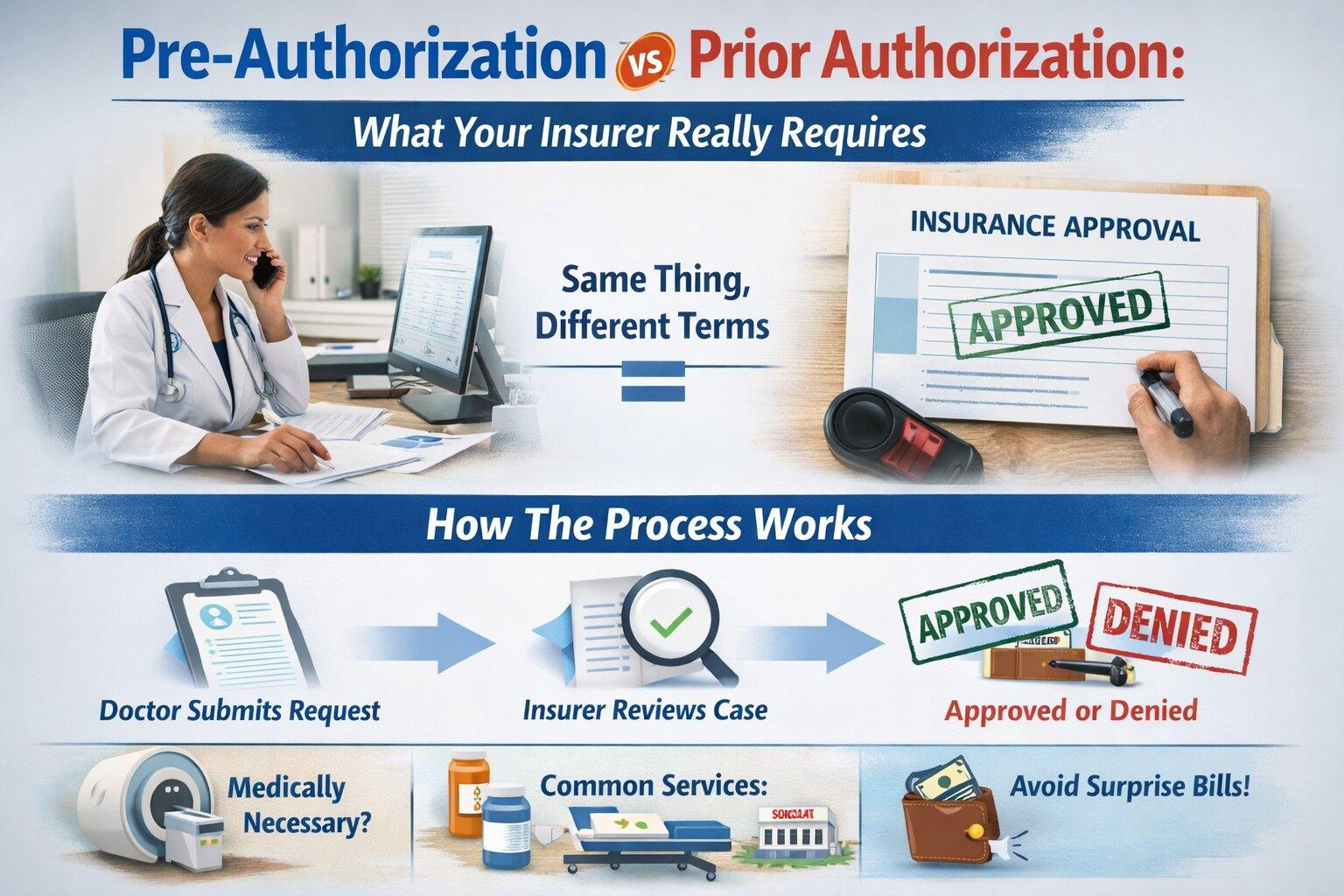
You call your doctor's office to schedule a procedure and the front desk says you need prior authorization first. A few days later, your insurer sends a letter referencing pre-authorization. You start wondering if these are two different things or if someone made a typo. This is one of the most common points of confusion in health insurance, and it costs people real money when they get it wrong.
The short answer is that pre-authorization and prior authorization are the same thing. Insurers, hospitals, and doctors use both terms interchangeably, and some use shortened versions like prior auth or pre-auth. The process itself is what matters, and understanding how it works protects you from unexpected bills.
Why Insurers Require Authorization in the First Place
Health insurers use the authorization process to review certain treatments, procedures, and medications before they agree to cover them. This is not about whether your doctor thinks you need something. It is about whether your insurer considers it medically necessary under the terms of your specific plan.
The list of services that require authorization varies by insurer and by plan. Common ones include elective surgeries, MRI and CT scans, specialty medications, inpatient hospital stays, and referrals to out-of-network providers. Some plans require it for mental health treatment beyond a certain number of sessions. Others require it for durable medical equipment like wheelchairs or CPAP machines.
Your insurer is required by law to provide you with a list of services that need authorization. This is usually found in your summary of benefits and coverage document, which your insurer must provide at no cost. If you are unsure whether a procedure needs authorization, call the member services number on your insurance card before the appointment, not after.
What the Authorization Process Actually Looks Like
Authorization is almost always requested by your doctor's office, not by you directly. Your provider submits clinical documentation to your insurer that supports the medical necessity of the procedure. The insurer then reviews that information and either approves, denies, or requests more information.
Timelines matter here. The Centers for Medicare and Medicaid Services has established that for standard prior authorization requests, insurers must respond within a set number of days. For urgent requests, the window is shorter. Many states have passed laws tightening these timelines further, so the rules in your state may be stricter than federal minimums.
If your insurer approves the authorization, that approval is not a guarantee of payment. It means the service is covered if all other conditions of your plan are met. You still owe your deductible, copay, or coinsurance. Authorization does not waive your cost-sharing responsibilities.
If your insurer denies the authorization, you have the right to appeal. The denial letter must explain the reason for the decision and include instructions for how to file an appeal. Do not ignore a denial. Many are overturned on appeal, particularly when your doctor submits additional clinical notes or peer-reviewed evidence supporting the treatment.
Where People Run Into Trouble
The most expensive mistake is assuming that a referral is the same as an authorization. Your primary care physician writing a referral to a specialist does not mean your insurer has authorized the specialist visit. These are separate steps, and skipping the authorization piece means you may receive the full bill as if you had no insurance at all.
The second common mistake is not verifying that the authorization is still valid when your appointment date arrives. Authorizations expire. If your procedure gets rescheduled and the authorization lapses, your provider needs to request a new one before the appointment takes place.
A third issue involves out-of-network providers. Even when a procedure is authorized, if any member of the care team is out of network, that individual's services may not be covered at the same rate. This happens frequently in surgical settings where an anesthesiologist or assistant surgeon is brought in who does not participate in your plan. Federal protections under the No Surprises Act limit some of these situations, but not all of them.
Understanding what a health insurance network covers and excludes goes hand in hand with understanding authorization requirements, because both determine how much of your bill your insurer will actually pay.
How to Protect Yourself Before Any Procedure
Start by calling your insurer and asking two direct questions. Ask whether the procedure requires prior authorization. Ask whether the provider performing it is in-network. Get the name of the representative and the reference number for the call.
If authorization is required, confirm with your doctor's office that they have submitted the request and ask them to notify you once it is approved. Do not assume it is being handled. Follow up if you have not heard anything within a few days of the expected response window.
Keep a paper trail. Save the approval letter or the confirmation number your insurer provides. If a billing dispute arises later, that documentation is your strongest evidence that the service was authorized before it was performed.
The Department of Health and Human Services offers consumer resources that explain your rights around coverage decisions and appeals. Your state's insurance commissioner website is another resource for understanding protections that apply in your specific state.
Prior authorization is one of those processes that feels like a bureaucratic obstacle, and sometimes it genuinely is. But handling it correctly from the start means fewer surprises on your explanation of benefits and a much lower chance of paying out of pocket for something your plan was supposed to cover.