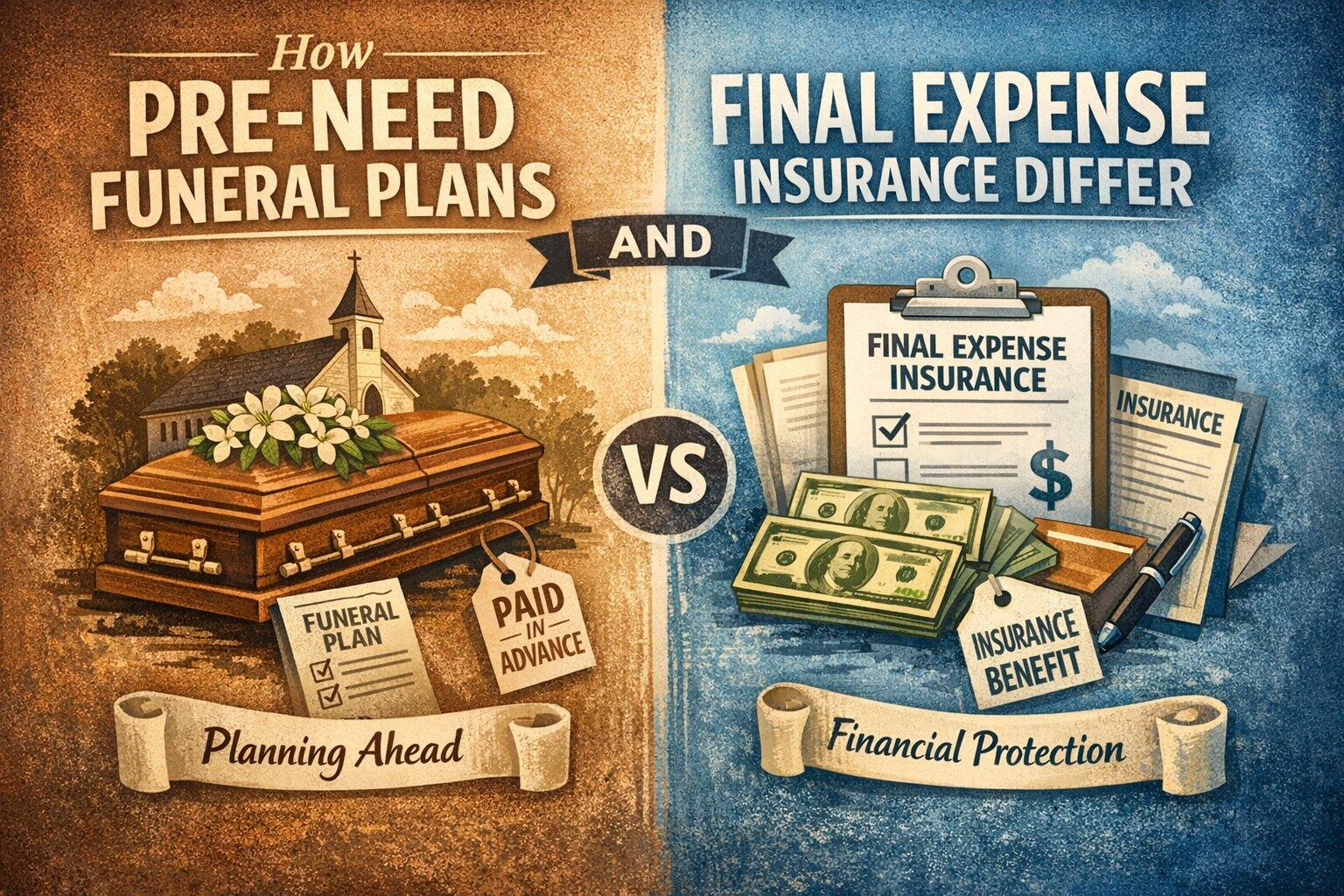
Two products both claim to solve the same problem. Pre-need funeral plans and final expense insurance are both designed to handle end-of-life costs, but they work in very different ways and serve different planning goals. Choosing the wrong one for your situation has real consequences for your family. Choosing the right one, or the right combination of both, makes a difficult time meaningfully easier for the people you leave behind.
The confusion between the two products is understandable. Both are sold to older adults thinking about the future. Both are framed as responsible planning. But the mechanics are fundamentally different, the protections they offer are different, and the risks they carry are different. Understanding those differences is the only way to make a decision that actually fits your circumstances rather than the pitch you received.
How Each Product Works and What It Actually Delivers
A pre-need funeral plan is a contract between you and a specific funeral home. You pay for your funeral in advance, either in a lump sum or through installments, and the funeral home agrees to provide specific services at the price you lock in today. The appeal is straightforward. You protect your family from making difficult decisions under emotional pressure, you lock in today's prices against future inflation, and you get to choose exactly what your funeral looks like while you are still in a position to make those choices thoughtfully.
Pre-need plans are detailed and specific. They identify the exact services to be provided, the specific merchandise to be used, and the price that has been agreed upon. When done well, a pre-need plan is a genuine gift to the family. It removes the guesswork, removes the pressure to make expensive decisions during grief, and removes the uncertainty about what the deceased would have wanted. Those are real benefits that should not be dismissed.
Final expense insurance is a whole life insurance policy with a small face amount, typically between $5,000 and $25,000. The policyholder pays a monthly or annual premium, and the policy pays a cash death benefit to the named beneficiary when the insured passes away. The beneficiary has full control over how the money is used. It has the potential to pay for a funeral, cover outstanding medical bills, settle small debts, or handle any other immediate financial need the family faces. Final expense insurance is portable. It stays in force regardless of where you live or which funeral home your family ultimately chooses.
The flexibility of the death benefit is both the primary advantage and the primary limitation of final expense insurance. The money goes to the beneficiary as cash, which means the family is free to use it however the circumstances require. That flexibility is valuable in a world where exact circumstances at the time of death are unpredictable. It is less valuable if the goal is to ensure that specific wishes are carried out in a specific way, which is where pre-need planning has the advantage.
The Limitations Each One Carries
Pre-need plans are tied to a specific funeral home. If you move to another city or state, the plan may not transfer cleanly. Some pre-need contracts are transferable to affiliated funeral homes in other areas, but many are not, or the transfer process involves complications and additional costs. If the funeral home goes out of business, the funds may be at risk depending on how your state regulates the escrow of pre-need funds.
State regulations on pre-need plans vary significantly. Some states require funeral homes to place 100% of pre-need funds in a trust. Others allow the funeral home to retain a portion of the funds. A few states have minimal regulation, which means the consumer's protection depends heavily on the financial stability of the funeral home itself. Understanding your state's rules before signing a pre-need contract is essential. This information is available from your state's funeral regulatory board, and a reputable funeral home should be able to explain it clearly.
Pre-need plans also cover only the specific services listed in the contract. Costs that were not anticipated at the time of signing, such as transportation from a different city, additional services the family adds, or costs that arise from circumstances the contract did not address, are not covered. The plan pays for what was specified and nothing more. Families sometimes discover at the time of need that the plan covers the core expenses but leaves unexpected costs uncovered.
Final expense insurance does not lock in funeral prices. The death benefit is a fixed dollar amount. If funeral costs rise significantly between the time you purchase the policy and the time of your death, the benefit may not fully cover the expense. A policy purchased ten years ago at $10,000 may not be adequate for a funeral that costs $12,000 today. Inflation erodes the purchasing power of a fixed benefit over time, which is a real limitation for policies held over many years.
Policies with health questions may have a waiting period of up to two years before the full death benefit is available. Policies that guarantee acceptance without health questions typically cost more for the same face amount. The beneficiary controls the funds, which is usually an advantage. In families where the beneficiary is not the most financially responsible person, that flexibility has the potential to create problems if the funds are spent on something other than funeral costs.
Choosing the Right Option for Your Situation
Pre-need plans are better suited for someone who has a strong preference for a specific funeral home, has clear wishes about their service that they want documented and guaranteed, and is confident they will remain in the same geographic area. They are also well-suited for someone who wants to protect their family from the full burden of decision-making during grief and who trusts the specific funeral home they are working with.
Final expense insurance is better suited for someone who wants flexibility, has a mobile lifestyle or is uncertain about their future location, wants to leave their family discretion over the details, or prefers an insurance product regulated by a state insurance department rather than a funeral home contract. It is also better suited for someone whose family members are financially responsible and can be trusted to use the death benefit as intended.
A combination of both is also a reasonable approach. Some families use a smaller pre-need plan to lock in core services at a preferred funeral home and pair it with a final expense insurance policy to cover the remaining and unpredictable costs. The pre-need plan handles the guaranteed portion, and the insurance handles the flexibility. That combination provides more of the benefits of each product while reducing the limitations of relying on either one alone.
Start by getting a written price list from local funeral homes. Most states require funeral homes to provide this list by law. Then compare what a pre-need plan at your preferred funeral home would cost against the premium for a final expense insurance policy with a comparable death benefit. The math often makes the better choice clear, and the right answer is usually the one that fits your specific planning goals rather than the one that was presented to you first.