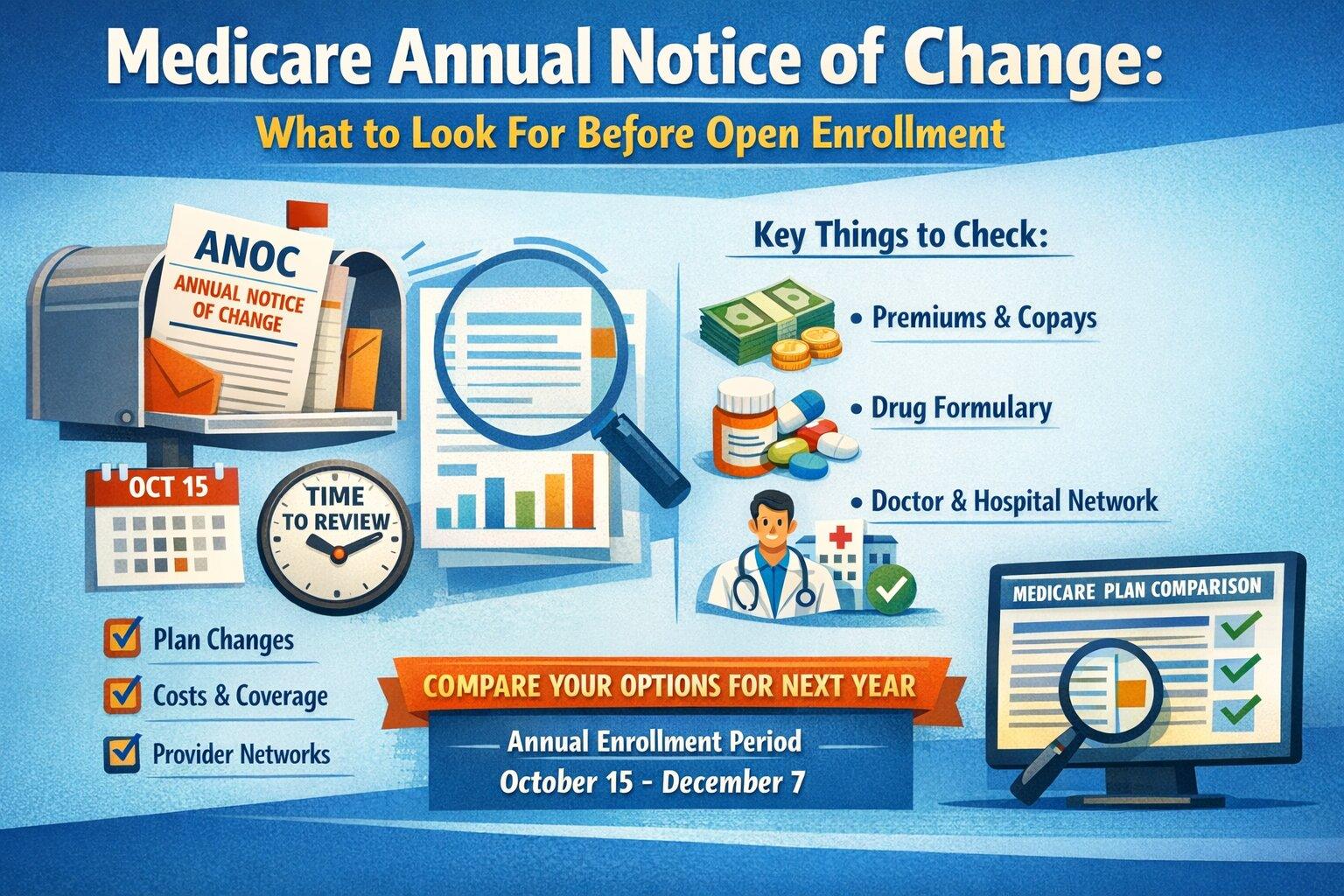
Every fall, Medicare Advantage and Part D prescription drug plan members receive a document called the Annual Notice of Change, sometimes referred to as the ANOC. It arrives in the mail in late September, before the Annual Enrollment Period opens on October 15. Most people set it aside unopened or glance at it briefly before discarding it. That is a costly habit. The Annual Notice of Change describes every material change your plan is making for the coming year, and some of those changes can significantly affect what you pay for coverage and care.
Taking 30 to 45 minutes to review this document before the Annual Enrollment Period begins is one of the highest-value uses of your time during the Medicare calendar. The information in it tells you whether your current plan still serves your needs or whether switching during the enrollment period would save you money and improve your coverage. Plans change every year. Assuming that the plan you chose last year is still the best option for next year is an assumption that costs many Medicare beneficiaries real money.
What the Annual Notice of Change Is and Why It Matters
The Annual Notice of Change is a federally required document that Medicare Advantage and Part D plan sponsors must send to all enrolled members by September 30 each year. It discloses all changes to the plan's costs, benefits, and coverage rules that will take effect on January 1 of the following year. CMS, which is the Centers for Medicare and Medicaid Services, mandates specific content and formatting requirements to ensure the document covers all material changes in a standardized way.
The notice covers changes to premiums, deductibles, copays, coinsurance, out-of-pocket maximums, and the plan's drug formulary. It also discloses changes to the plan's provider network and any changes to prior authorization requirements for specific services. If the plan is making favorable changes, such as adding a benefit or reducing a copay, those are disclosed as well. The document is legally required to be accurate and complete, and it represents the plan's official communication about what is changing.
The Annual Notice of Change matters because Medicare plans have the ability to make significant changes from one year to the next. A plan that was the best available option in your area last year may have raised its premium, changed its formulary to move your medications to a higher cost tier, narrowed its provider network to exclude a hospital or specialist you use, or increased its cost-sharing in ways that make it more expensive than competing plans. Without reviewing the ANOC, you would not know any of this until you encountered the changes after January 1, when it is too late to switch without waiting for the next enrollment period.
Many Medicare beneficiaries have experienced the frustration of discovering a significant plan change after the Annual Enrollment Period has closed. A formulary change that moved a critical medication to non-preferred status, a premium increase that made the plan substantially more expensive, or a network change that dropped a preferred specialist are all examples of changes that could have prompted a plan switch during the enrollment period but that were missed because the ANOC was not reviewed. Reviewing it every year is the only reliable way to stay ahead of those changes.
The Changes That Most Affect Your Costs and Coverage
Premium changes are the most visible item in the Annual Notice of Change and the one most people notice if they review the document at all. The plan's monthly premium is stated clearly, and the change from the current year's premium is typically highlighted. However, the premium alone is not the right number to evaluate. A plan with a slightly higher premium that has lower cost-sharing for services you use frequently may cost less in total than a plan with a lower premium but higher copays and coinsurance.
Formulary changes are often more financially significant than premium changes for beneficiaries who take regular medications. A formulary is a list of covered drugs organized into cost tiers, with different cost-sharing amounts at each tier. Plans review and update their formularies each year. A drug that was on Tier 2 with a modest copay can move to Tier 3 or Tier 4 with significantly higher cost-sharing, or it can be removed from the formulary entirely and require prior authorization or a formulary exception to be covered at all.
Look up each medication you take in the new formulary for the coming year. The Annual Notice of Change will indicate if the formulary is changing and will reference the updated formulary document. Use the plan's online formulary lookup tool to check your specific medications under the new formulary. If a drug you depend on has moved to a higher tier or been removed from the formulary, that change alone can justify switching plans during the Annual Enrollment Period.
Provider network changes are the other category of change that can force unwanted action if discovered too late. Medicare Advantage plans use provider networks, and when a hospital or physician group leaves the network, plan members who were seeing those providers must either change providers or pay out-of-network rates. The ANOC will disclose if significant network changes are occurring, but verifying the specific providers you use is something you should do directly with the plan or through the plan's online directory.
How to Use the Notice to Make a Better Open Enrollment Decision
Start by reading the summary of changes at the beginning of the ANOC. This section highlights the most material changes in a condensed format. After reading the summary, go through the rest of the document systematically, paying particular attention to cost-sharing changes for the types of services you actually use. If you had a hospitalization last year, look at how the inpatient cost-sharing is changing. If you see specialists regularly, look at specialist copay changes. Focus on the categories that reflect your actual healthcare use, not hypothetical scenarios.
After reviewing the ANOC, use the Medicare Plan Finder tool at Medicare.gov to compare your current plan against other available plans in your area for the coming year. Enter your zip code, your current medications with dosages, and your preferred pharmacy to see a side-by-side comparison of available plans including your current plan. The tool calculates estimated total annual costs including premiums, deductibles, and expected drug costs based on your specific medication list. That estimated total cost comparison is more useful than comparing premiums alone.
If you are considering switching plans, verify that your preferred doctors, specialists, and hospitals are in-network for the new plan before completing the switch. Call the plan directly to confirm network participation rather than relying solely on the online directory, which may not be fully current. Confirm that your medications are on the new plan's formulary at a tier you can afford. Then make the switch during the Annual Enrollment Period, which closes December 7, with the new coverage taking effect January 1.
If you are satisfied with your current plan after reviewing the ANOC and comparing alternatives, no action is required. Your current plan enrollment continues automatically for the coming year. The value of the annual review is that you make an active, informed decision to stay rather than a passive decision by default. That distinction matters because the best plan for your situation is more likely to be the plan you chose deliberately than the one you stayed in without looking.